
As commercial transportation and industrial operations continue to expand, businesses face increasing challenges in vehicle safety, driver supervision, accident investigation, and fleet management. Public transport operators, logistics companies, school bus providers, and industrial vehicle users need reliable ways to monitor road conditions, improve visibility, and obtain useful video evidence when incidents occur.
A Vehicle Camera System provides a practical solution by combining vehicle-mounted cameras with displays, recording equipment, and, where required, intelligent monitoring functions. Depending on the configuration, a system can capture front, rear, side, and in-cabin views, helping operators improve situational awareness and manage vehicle-related risks.
For international automotive electronics importers, wholesalers, vehicle manufacturers, and system integrators, choosing the right vehicle camera solution involves more than comparing camera specifications. Buyers must consider application requirements, recording capabilities, environmental durability, system compatibility, customization, and after-sales support.
MCY Technology supplies vehicle cameras, mobile digital video recorders (MDVRs), AI-assisted safety systems, and other in-vehicle monitoring products. This guide explains how a Vehicle Camera System works, its applications across different industries, and the key factors B2B buyers should evaluate before selecting a supplier.
1. What Is a Vehicle Camera System?
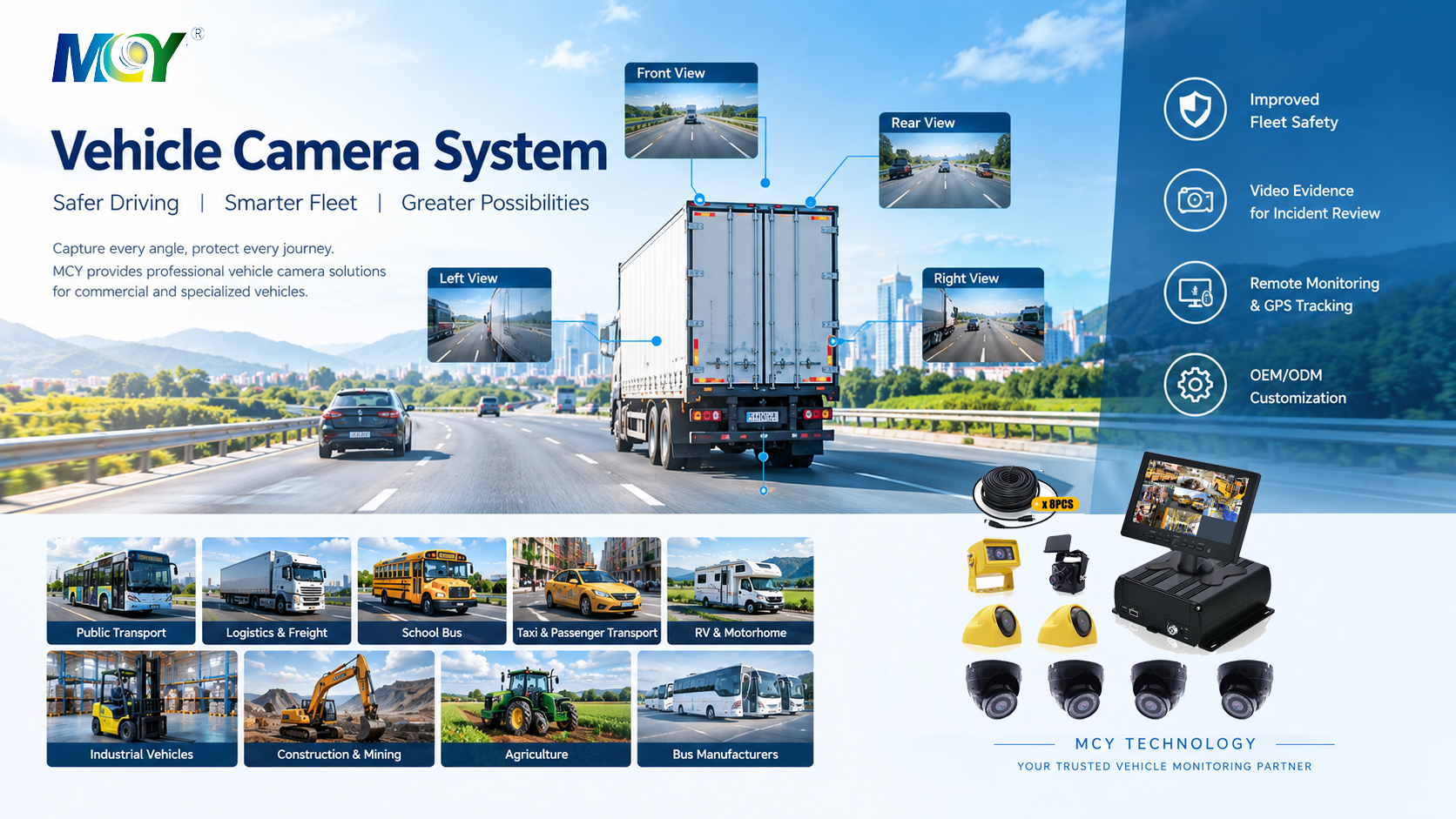
A Vehicle Camera System is an integrated monitoring solution designed to capture visual information from around or inside a vehicle. Depending on the intended application, it may include cameras, in-cabin monitors, recording devices, communication modules, and intelligent detection functions.
Unlike a basic reversing camera, a comprehensive vehicle monitoring system can cover several viewing areas and support both real-time observation and recorded-video review.
Typical system components include:
- Vehicle cameras: Capture front, rear, side, cabin, or cargo-area footage.
- In-cabin monitors: Display camera images to help drivers observe surrounding conditions.
- Mobile DVR: Records footage from connected cameras and supports playback or video retrieval.
- GPS and connectivity modules: Support vehicle location tracking and, on compatible systems, remote monitoring.
- AI safety functions: Selected configurations can provide driver alerts or detect specified road users and driving risks.
The configuration depends on vehicle type, operating environment, and project requirements. A school bus may need exterior and passenger-area monitoring, while a forklift may require cameras positioned to help the operator observe pedestrians and nearby obstacles.
MCY offers a range of vehicle surveillance products and application-specific solutions. Buyers can explore the MCY vehicle monitoring solutions to identify relevant system configurations.
2. How a Vehicle Camera System Improves Fleet Safety
2.1 Vehicle Camera System for Blind Spot Visibility
Large vehicles often have substantial blind spots caused by their dimensions, body structure, and operating position. These areas can create challenges during turning, reversing, lane changes, loading, and manoeuvring in confined spaces.
A multi-camera Vehicle Camera System can provide additional views of the vehicle’s surroundings. Depending on camera placement, the driver may be able to observe areas that are difficult to see through conventional mirrors alone.
For buses, trucks, construction machinery, and agricultural vehicles, camera positioning is especially important. Buyers should evaluate the required viewing zones and determine whether standard cameras, side-view cameras, or a surround-view configuration would be appropriate.
2.2 Vehicle Camera System for Driver Assistance
Some vehicle monitoring systems incorporate Advanced Driver Assistance Systems (ADAS), Driver State Monitoring (DSM), or Blind Spot Detection (BSD).
These technologies perform different functions:
- ADAS can provide warnings for supported driving risks, such as forward collision or lane departure.
- DSM can identify selected driver behaviours, such as signs of fatigue or distraction, when supported by the configuration.
- BSD can help detect specified road users or vehicles in designated blind spot areas.
MCY offers camera systems and monitoring solutions incorporating selected intelligent safety functions. The availability of each feature depends on the product and installation.
These systems are designed to support driver awareness rather than replace attentive driving, training, or established safety procedures.
2.3 Vehicle Camera System for Accident Prevention and Review
A properly configured camera system can support safer manoeuvring by giving drivers additional visual information. Recording equipment can also preserve footage for later investigation.
For fleet managers, this combination is valuable because it supports both preventive safety management and post-incident review. Video may help clarify the sequence of events surrounding a collision, vehicle damage, passenger complaint, or disputed driving incident.
However, the usefulness of recorded evidence depends on camera coverage, recording continuity, image quality, timestamps where supported, and applicable evidence requirements.
3. Vehicle Camera System Applications Across Different Industries
3.1 Public Transportation and Bus Fleets
Public transport operators must manage passenger safety, crowded roads, frequent stops, and interactions with pedestrians and cyclists. A suitable Vehicle Camera System can monitor the road ahead, vehicle sides, rear areas, and passenger compartment.
For bus manufacturers and fleet operators, a multi-camera solution can support driver awareness and incident investigation. When connected to compatible recording equipment, it can also help preserve footage for reviewing passenger incidents or traffic disputes.
Procurement teams should consider the number of cameras required, storage capacity, driver display arrangement, passenger privacy, and maintenance access.
MCY’s Camera DVR Kits provide a starting point for evaluating integrated vehicle recording and monitoring solutions.
3.2 School Bus Operators
School buses operate in environments where children may move around the vehicle during boarding, departure, and roadside stops. Monitoring both the exterior and, where appropriate, the passenger compartment can help operators review incidents and assess operating procedures.
A Vehicle Camera System may include front, rear, side, and cabin cameras, depending on the vehicle layout and local requirements. Selected systems can also incorporate recording and driver assistance functions.
School bus operators should verify camera coverage, recording retention, installation quality, and relevant privacy obligations. Any required warning systems or specialized school bus safety equipment should be evaluated separately rather than assumed to be included in a standard camera package.
3.3 Logistics and Freight Transportation
Trucks and delivery vehicles encounter risks associated with road accidents, cargo disputes, theft, driver behaviour, and difficult loading environments.
A Vehicle Camera System can record driving conditions and provide footage from selected vehicle areas. When combined with a compatible Mobile DVR, GPS, and remote connectivity, it can support vehicle tracking, remote video access, and historical route review.
MCY’s AI MDVR Camera System for logistics transport is relevant to buyers evaluating integrated recording and fleet monitoring capabilities.
For logistics companies, key purchasing considerations include the number of camera channels, recording storage, connectivity availability, footage retrieval, and the ability to support the fleet’s daily operating schedule.
3.4 Taxi and Passenger Transport Companies
Taxi fleets and passenger transport operators need practical ways to review incidents, protect drivers and passengers, and manage vehicles across different routes.
A suitable camera configuration may include road-facing and cabin-facing cameras, with recording functions selected according to business needs and applicable laws.
For these buyers, image quality, reliable recording, easy footage retrieval, and clear privacy procedures are important. Distributors and installers should also consider whether a standardized configuration can be used across several vehicle models to simplify installation and maintenance.
3.5 Recreational Vehicles and Motorhomes
RVs and motorhomes have larger dimensions than many passenger cars, making parking, reversing, and manoeuvring more challenging.
A Vehicle Camera System can provide front, rear, and side views to assist drivers in confined spaces. Depending on the configuration, multiple cameras can be combined with a monitor or surround-view solution.
RV manufacturers, conversion workshops, and distributors should evaluate camera positioning, display size, weather exposure, wiring, and compatibility with the vehicle’s electrical system.
3.6 Forklifts, Construction, Mining, and Agricultural Vehicles
Industrial vehicles often operate in environments with restricted visibility, moving workers, heavy equipment, dust, vibration, and changing light conditions.
A camera system can help operators observe areas around machinery that are difficult to see directly. Depending on the application, buyers may require rear-view cameras, multi-camera monitoring, wireless camera systems, AI pedestrian detection, or proximity warning functions.
MCY provides solutions for engineering and construction vehicles and other specialized vehicle applications. For industrial projects, the system should be selected according to the machine’s movement, operating environment, worker safety requirements, and installation constraints.
4. Vehicle Camera System for Video Evidence and Fleet Management
4.1 Reliable Video Recording for Incident Investigation
A major reason businesses install a Vehicle Camera System is to preserve footage that may be needed after an incident.
A compatible recording system can help fleet managers review collisions, vehicle damage, loading disputes, driver complaints, and other operational events. Depending on the configuration, recordings may include several camera views, making it easier to understand the surrounding circumstances.
Buyers should verify recording resolution, camera channel capacity, storage options, recording modes, and video retrieval procedures before purchasing.
4.2 Remote Monitoring and GPS Tracking
For fleets operating across multiple locations, remote monitoring can reduce the need to inspect each vehicle physically.
Compatible systems may support live video access, GPS positioning, historical route playback, and remote video retrieval through supported software or applications.
These capabilities can help fleet managers review vehicle movements and investigate reported incidents. Connectivity, data usage, platform compatibility, and network coverage should be assessed for the intended market.
4.3 Supporting Driver Management
Recorded footage and selected AI functions can contribute to internal driver training and safety reviews.
Fleet managers may use relevant footage to discuss risky manoeuvres, review operating procedures, and identify recurring safety concerns. Where supported, driver monitoring and ADAS alerts can provide additional information for safety management.
Businesses should establish clear policies governing who can access recordings, how long footage is retained, and how employee and passenger privacy is protected.
5. How to Choose the Right Vehicle Camera System
Selecting a suitable system requires a clear understanding of the vehicle, application, and business objectives.
5.1 Define Camera Coverage Requirements
Start by identifying which areas need monitoring. A basic reversing application may require only a rear camera and display, while a commercial fleet may need front, side, rear, and cabin coverage.
Consider the vehicle’s dimensions, mounting locations, expected viewing angles, and whether additional cameras are required for loading or pedestrian monitoring.
5.2 Evaluate Image Quality and Environmental Durability
Camera performance should be assessed under the conditions in which the vehicle actually operates.
Important factors include daytime and nighttime image quality, backlight handling, vibration resistance, temperature range, water protection, dust exposure, and connector durability.
For mining, agriculture, and construction applications, request the relevant environmental specifications and supporting documentation for the exact model. Do not assume that all products in a supplier’s range have identical protection ratings.
5.3 Confirm Recording and Connectivity Capabilities
If video evidence is a core requirement, determine whether the system includes a recording unit or requires a separate Mobile DVR.
Confirm the number of supported camera channels, storage method, recording settings, GPS functionality, and remote access capabilities. Also consider how footage will be retrieved when connectivity is unavailable.
MCY’s Mobile DVR product range provides additional information about recording and vehicle monitoring options.
5.4 Assess Customization and System Integration
Vehicle manufacturers, conversion workshops, and system integrators often need configurations tailored to their projects.
Customization discussions may cover:
- Camera types, quantities, and mounting positions.
- Monitor size and installation location.
- Recording capacity and connectivity.
- Integration with ADAS, DSM, BSD, or other compatible equipment.
- Wiring, connectors, and vehicle electrical compatibility.
- Branding, packaging, documentation, and production schedules.
Provide vehicle drawings, application details, estimated quantities, and destination-market requirements when requesting a quotation. The supplier can then evaluate feasibility and confirm the proposed configuration.
5.5 Compare Total Cost of Ownership
The lowest unit price does not always produce the lowest overall operating cost.
Purchasers should account for installation, vehicle downtime, storage equipment, replacement cameras, maintenance, technical support, and warranty terms.
Importers and wholesalers should also review product consistency, spare-part availability, packaging requirements, and delivery planning. Clear agreements on these matters can help reduce project delays and simplify long-term support.
6. Why Choose MCY Technology for Your Vehicle Camera System?
MCY Technology Limited specializes in vehicle safety vision and intelligent monitoring solutions for commercial and specialized vehicles. Its published portfolio includes cameras, monitors, Mobile DVRs, electronic side mirrors, AI-assisted safety systems, and surround-view solutions.
For B2B customers, MCY offers several areas to explore when developing a vehicle monitoring project:
- Multiple application options: Solutions for public transport, logistics, recreational vehicles, construction equipment, and agricultural machinery.
- Integrated monitoring products: Cameras and compatible recording or display equipment for different system configurations.
- Intelligent safety functions: Selected products incorporate ADAS, DSM, BSD, or AI-assisted detection.
- OEM/ODM cooperation: MCY welcomes project discussions concerning customization and product configuration.
- Project-oriented technical evaluation: Buyers can discuss camera coverage, recording requirements, installation arrangements, and system integration before ordering.
Learn more about the company through its official website and explore the relevant product pages before contacting the sales team.
Product specifications, feature availability, approvals, and compatibility should always be confirmed for the exact model and intended destination market.
7. Frequently Asked Questions About Vehicle Camera System
Q1. What does a Vehicle Camera System include?
Depending on the application, it may include vehicle cameras, an in-cabin monitor, a Mobile DVR, GPS or communication modules, and selected AI safety functions. The configuration depends on the vehicle and project requirements.
Q2. Can a Vehicle Camera System record video for accident investigations?
Yes, when the selected configuration includes compatible recording equipment. Buyers should verify storage capacity, recording settings, video retrieval methods, and the requirements for preserving usable evidence.
Q3. Can the system support remote fleet monitoring?
Selected configurations support remote video monitoring and GPS tracking through compatible connectivity and software. Availability depends on the specific equipment, network coverage, and platform requirements.
Q4. Is a Vehicle Camera System suitable for school buses and industrial vehicles?
Yes, suitable configurations can be developed for these applications. Camera placement, environmental protection, recording requirements, and applicable safety rules must be assessed for each vehicle type.
Q5. Does MCY Technology provide customized solutions?
MCY offers OEM/ODM services and a range of vehicle monitoring solutions. Buyers can contact the company to discuss camera configuration, recording requirements, system integration, and other project-specific needs.
Q6. How can I request a quotation from MCY?
Provide your vehicle type, application, required camera views, estimated order quantity, destination market, and customization requirements. MCY’s sales team can then help clarify suitable options and quotation details.
Conclusion: Build a More Effective Vehicle Monitoring Solution
A Vehicle Camera System can help businesses improve vehicle visibility, preserve video evidence, and strengthen fleet management procedures. From buses and school transportation to logistics fleets, RVs, forklifts, and agricultural machinery, the right configuration depends on the vehicle’s operating environment and specific safety objectives.
For international buyers, successful procurement requires careful evaluation of camera coverage, recording capabilities, connectivity, environmental durability, customization, and long-term support.
MCY Technology provides vehicle cameras, Mobile DVRs, intelligent monitoring products, and OEM/ODM cooperation opportunities for a range of commercial and specialized vehicle applications.
Contact MCY Technology to discuss your Vehicle Camera System project. Share your target vehicle type, camera coverage requirements, video evidence needs, estimated quantity, and customization expectations to request product information and a quotation.
Website: https://www.mcytech.com/
Email: sales@mcytech.com
Phone: +86-760-86638369
Post time: Oct-22-2026