
Forklifts are essential for moving goods in warehouses, distribution centers, factories, ports, and industrial facilities. However, limited visibility around the vehicle can make daily operations challenging. Loads may block the operator’s forward view, the mast and forks can create blind spots, and pedestrians may enter the operating area unexpectedly. These risks become more significant when forklifts operate in narrow aisles or busy loading zones.
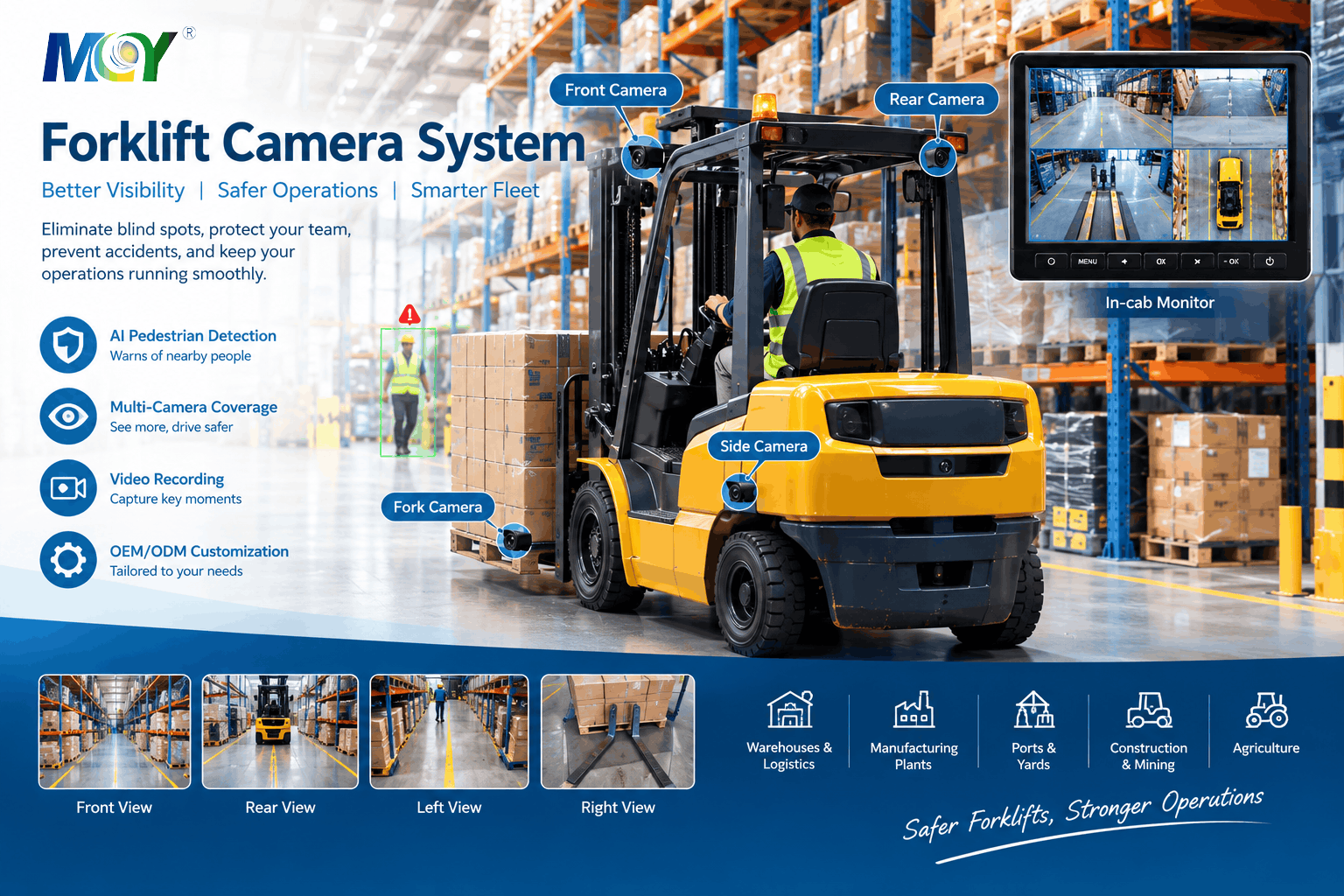
A Forklift Camera System helps operators gain a clearer view of critical areas around the vehicle. By using cameras mounted near the forks, rear of the forklift, or other strategic positions, the system can support safer load handling, reversing, and maneuvering. Depending on the configuration, additional features such as AI pedestrian detection, audible and visual alerts, wireless transmission, and video recording can provide further support for industrial vehicle safety.
For warehouse operators, logistics companies, forklift manufacturers, equipment distributors, and system integrators, selecting the right Forklift Camera System means considering more than image quality. Camera placement, detection requirements, installation methods, working conditions, and evidence management all affect the suitability of a solution.
MCY Technology provides forklift camera products and vehicle safety solutions for industrial applications. Its product range includes wireless camera systems, AI-based detection products, monitors, and mobile DVR equipment that can be evaluated according to different operating requirements.
What Is a Forklift Camera System?
A Forklift Camera System is a visual monitoring solution designed to help forklift operators see areas that may be difficult to observe directly from the driving position. A typical system may include one or more cameras, an in-cab monitor, wireless or wired connections, and optional detection or recording functions.
Unlike a standard reversing camera designed primarily for rear visibility, a forklift camera system can be configured around the vehicle’s working tasks. A fork-mounted or fork-view camera can help the operator observe load positioning, while rear-view cameras can provide additional visibility during reversing. Side-view cameras may also be useful where the vehicle layout or operating environment creates specific blind spots.
MCY offers a 4Channel Wireless Backup AI Forklift Camera system with a wireless monitor, fork-view camera, backup cameras, and rechargeable batteries. The product information also describes AI-supported blind-spot detection, laser positioning, and night-vision capabilities on the relevant cameras.
The actual functions available depend on the selected model and configuration. Buyers should confirm camera compatibility, detection capabilities, recording options, and installation requirements before placing an order.
Why Is a Forklift Camera System Important?
1. Improve Visibility Around Forklift Blind Spots
Forklifts have several potential blind spots. The mast, overhead guard, load, and vehicle body can obstruct the operator’s view, particularly when carrying large pallets or stacking goods at height.
A Forklift Camera System can provide additional visual information from selected areas. A fork-view camera helps the operator observe the load-handling area, while a rear camera can make reversing easier to assess. Multiple camera views can be especially useful in warehouses where forklifts frequently turn, reverse, and operate close to shelving or equipment.
Improved visibility supports better decisions, but camera coverage should be planned according to the actual vehicle geometry and working environment. Operators should continue to follow site traffic rules, speed limits, pedestrian separation procedures, and safe load-handling practices.
2. Support Pedestrian Safety with AI Detection
Pedestrian safety is a major concern in warehouses, factories, logistics centers, and other industrial workplaces. Forklifts and pedestrians may share routes, cross at intersections, or work near loading and unloading areas.
An AI-enabled Forklift Camera System can provide an additional layer of awareness by detecting pedestrians in supported monitoring zones. Depending on the configuration, the system may activate audible or visual warnings when a person is detected near the forklift.
MCY’s Wireless AI Forklift Camera Warning System describes AI detection, multiple views, wireless transmission, audible alerts, and visual alerts. The solution also addresses the blind spots created by loads obstructing the fork area and the rear blind spot during reversing.
AI detection should not be treated as a guarantee that every person or hazard will be detected. Performance may depend on installation, camera positioning, lighting, occlusion, and operating conditions. Buyers should assess the detection zone and warning behavior for their specific application.
3. Improve Load Positioning and Handling Accuracy
Accurate load positioning is important when placing pallets on racks, handling goods at height, or working in narrow storage aisles. The operator may need to align the forks with pallet openings while judging the load’s distance from surrounding structures.
A Forklift Camera System with a suitable fork-view camera can help the operator observe the fork area and make adjustments during load engagement. Some configurations may include laser positioning to provide an additional visual reference for alignment.
This type of assistance can be useful in high-throughput warehouses, manufacturing facilities, and distribution centers where forklifts repeatedly perform similar handling tasks. However, camera images and positioning aids should be used alongside established lifting procedures and operator training.
4. Support Incident Review and Video Evidence
When a collision, damaged pallet, dropped load, or workplace incident occurs, it may be difficult to reconstruct the event from verbal reports alone. Video footage can help supervisors review the surrounding conditions and understand how the incident developed.
A Forklift Camera System connected to compatible recording equipment can preserve footage for authorized review. Depending on the setup, recorded video may help operators investigate equipment damage, review unsafe maneuvers, and improve training procedures.
If video evidence is an important requirement, buyers should clarify whether the selected system supports recording, what camera views are captured, how long footage can be stored, and how recordings are retrieved. Not every wireless camera kit includes onboard recording, so storage and recording capabilities must be confirmed separately.
Key Features to Consider in a Forklift Camera System
Multiple Camera Views
Different camera positions serve different purposes. A fork-view camera focuses on load handling, while a rear-view camera supports reversing. Additional cameras may be required for side visibility or other vehicle-specific blind spots.
Before choosing a system, map the forklift’s main operating movements and identify the areas that operators cannot easily see. The objective is to select useful coverage rather than simply adding cameras without a clear purpose.
Wireless Camera Transmission
Wireless camera systems can simplify installation where running cables along a moving mast or fork assembly would be difficult. They may also be suitable for retrofitting existing forklifts or supporting installations where flexibility is important.
MCY’s wireless forklift products describe wireless transmission, automatic pairing, and magnetic mounting options on applicable models. Buyers should verify the communication range, power arrangement, mounting suitability, and wireless performance in the intended facility.
Monitor and Image Display
The monitor should provide a clear view of the selected camera feeds and be positioned so the operator can check the image without unnecessary distraction. The screen layout should match the number of cameras and the tasks the operator performs.
A multi-view display can help operators switch between the fork area and reversing view. The appropriate arrangement depends on the forklift design, operator position, and working procedures.
AI Alerts and Warning Indicators
AI detection can add a warning layer to visual monitoring. Depending on the product, alerts may be audible, visual, or both. Some solutions may also incorporate warning lights to make nearby personnel more aware of a forklift’s presence.
Buyers should ask how detection zones are configured, what triggers an alert, and whether warning indicators are suitable for the noise and lighting conditions of the facility. Detection systems should complement, not replace, physical separation, traffic management, and operator training.
Recording and Fleet Monitoring
For larger operations, video recording and fleet monitoring may be important. A compatible mobile DVR can help centralize footage from supported cameras and may provide GPS or remote monitoring functions depending on the model and configuration.
MCY’s Mobile DVR products include configurations supporting video storage, playback, GPS positioning, and remote video monitoring. Since forklift installations differ from road vehicles, buyers should confirm whether the intended recorder, camera interfaces, power supply, and mounting arrangements are appropriate for their equipment.
How to Choose the Right Forklift Camera System
1. Identify the Operating Environment
Start by assessing where the forklift operates. A compact warehouse forklift may require different camera coverage from equipment used in a port, outdoor yard, manufacturing plant, or construction site.
Consider aisle width, lighting, dust, moisture, vibration, traffic flow, and the types of loads handled. These factors affect camera placement, housing requirements, display visibility, and installation planning.
2. Define the Main Safety Objectives
Identify the problems the system needs to address. Common priorities include:
- Improving visibility when loads obstruct the forward view.
- Monitoring the fork area during pallet engagement.
- Improving rear visibility during reversing.
- Detecting pedestrians in designated blind spots.
- Providing audible or visual warnings.
- Recording incidents for later review.
- Integrating camera feeds into an existing monitoring system.
A clear list of priorities helps prevent unnecessary features from complicating the installation or increasing the project cost without addressing the main operational risks.
3. Check Camera Placement and Mounting
Camera mounting should account for movement of the mast, fork assembly, and vehicle body. The selected position must provide a useful view while remaining suitable for the forklift’s normal operation.
Magnetic mounts may simplify installation on compatible products, but buyers should verify mounting strength and suitability for vibration, impacts, and the intended surface. Permanent installations may require different mounting arrangements.
4. Evaluate Wireless Performance and Power
For wireless systems, confirm the transmission arrangement, operating range, and expected performance around metal racks, machinery, and other potential sources of interference. The power supply should also match the installation design.
Rechargeable cameras can simplify some retrofits, but fleet managers should consider charging routines, battery maintenance, and operating hours. Wired and wireless approaches each have different installation and maintenance implications.
5. Confirm Recording and Integration Requirements
If the goal includes video evidence, verify the recording architecture before purchasing. Ask whether footage is recorded locally, whether a separate DVR is required, how recordings are exported, and whether the system supports the desired number of camera feeds.
For integration projects, also confirm compatibility with existing displays, monitoring platforms, and vehicle power systems. Do not assume that every camera, monitor, or recorder can be combined without checking its interface and specifications.
6. Plan Maintenance and Operator Training
A camera system is most useful when operators understand how to interpret its images and warnings. Training should cover camera views, system limitations, warning responses, and procedures for reporting faults.
Routine checks should include camera cleanliness, mounting security, monitor operation, wireless connectivity where applicable, and recording status if the system includes video storage. A clear maintenance process helps keep the equipment useful over time.
Forklift Camera System Applications Across Industries
Warehouses and Distribution Centers
Forklifts in warehouses move pallets through aisles, staging areas, loading docks, and storage racks. A camera system can assist with load positioning and reversing while helping operators observe selected blind spots. AI detection may provide additional warnings where pedestrian traffic overlaps with forklift routes.
Manufacturing Facilities
Manufacturing sites often use forklifts to move raw materials, components, and finished products between production lines and storage areas. Camera systems can support visibility in confined spaces and help supervisors review incidents involving goods or equipment.
Ports and Logistics Yards
Ports and logistics yards involve frequent movement of goods, vehicles, and personnel. The camera configuration should reflect the forklift’s task, the working surface, visibility conditions, and the interaction between vehicle operators and nearby workers.
Construction, Mining, and Agricultural Operations
Specialized industrial vehicles may operate in environments with dust, vibration, changing weather, and uneven surfaces. Camera solutions for these applications should be assessed for their mounting, environmental suitability, power arrangements, and maintenance requirements.
MCY provides a broader range of vehicle solutions for engineering, construction, logistics, and agricultural applications. Buyers can discuss the specific operating conditions to determine whether a forklift-focused or another vehicle monitoring configuration is more appropriate.
Why Consider MCY Technology for a Forklift Camera System?
MCY Technology supplies vehicle cameras, wireless monitoring products, AI-based detection systems, monitors, and mobile DVR equipment for different vehicle applications. Its forklift-focused product range includes multi-camera wireless kits and AI forklift warning solutions.
For warehouse operators and logistics companies, the key consideration is whether the proposed system addresses the real visibility and safety challenges in the workplace. For forklift manufacturers, distributors, vehicle modification companies, and system integrators, installation flexibility and compatibility with existing equipment may be equally important.
MCY also welcomes OEM/ODM projects. Buyers with specific requirements should provide the forklift model, camera coverage plan, detection needs, mounting constraints, and recording requirements so the configuration can be evaluated for the intended application.
When contacting MCY, it is helpful to share:
- Forklift type and operating environment.
- Main blind spots and load-handling tasks.
- Required camera positions and monitor arrangement.
- Whether AI pedestrian detection or warning lights are needed.
- Whether wireless transmission or recording is required.
- Existing equipment and integration requirements.
- Expected quantity and project schedule.
Frequently Asked Questions About Forklift Camera Systems
What does a Forklift Camera System do?
It provides additional visual coverage of selected areas around a forklift. Depending on the configuration, it can help operators observe the fork area, monitor reversing, and improve awareness of nearby pedestrians or obstacles.
Can a forklift camera detect pedestrians?
Some systems include AI-based pedestrian detection. MCY offers wireless AI forklift camera solutions with detection and warning functions. Buyers should confirm the detection zones and operating conditions for the selected model.
Does every Forklift Camera System record video?
No. Some camera kits focus on live viewing and warnings, while video recording may require compatible recording equipment. Confirm storage, recording, and footage retrieval requirements before ordering.
Are wireless forklift cameras suitable for retrofitting existing equipment?
Wireless systems can simplify some retrofit installations because they may reduce the need for extensive cable routing. Suitability depends on mounting conditions, wireless performance, power arrangements, and compatibility with the forklift.
Can a Forklift Camera System be customized?
Configuration requirements can vary by vehicle type and working environment. MCY welcomes OEM/ODM projects, and buyers can discuss camera placement, monitor arrangements, AI functions, wireless transmission, and integration requirements with the company.
Conclusion: Improve Forklift Safety with the Right Camera System
A Forklift Camera System can help address common visibility challenges in warehouses, factories, distribution centers, and industrial yards. By providing additional views of the fork area, rear blind spots, and selected surrounding zones, it can support load handling and safer maneuvering.
When AI pedestrian detection, audible or visual alerts, and compatible recording equipment are included, the system may also support workplace risk management and incident investigation. The right configuration depends on the forklift, operating environment, safety priorities, and integration requirements.
MCY Technology offers forklift camera products and vehicle monitoring solutions for different applications. Contact MCY to discuss a Forklift Camera System tailored to your equipment, blind-spot coverage, pedestrian detection, recording, and customization needs.
Website: https://www.mcytech.com/
Email: sales@mcytech.com
Phone: +86-760-86638369

Post time: Oct-30-2026