
As commercial vehicles become more advanced, manufacturers and fleet operators are paying greater attention to driver visibility, vehicle safety, and the integration of intelligent monitoring technologies. Traditional exterior mirrors remain widely used, but their physical size, viewing limitations, and exposure to environmental conditions have encouraged the adoption of camera-based alternatives.
An Electronic Side Mirror System uses external cameras and interior displays to provide drivers with a digital view of surrounding traffic. By replacing conventional mirror surfaces with camera-and-screen technology, this solution can help improve visibility in challenging driving environments and support safer vehicle operation.
For vehicle manufacturers, fleet integrators, importers, distributors, and engineering contractors, selecting the right system requires more than comparing screen sizes or product prices. Buyers must evaluate image quality, environmental durability, installation requirements, vehicle compatibility, and long-term supplier support.
This guide explains how an Electronic Side Mirror System works, where it can be used, and what B2B buyers should consider before placing an order. It also introduces MCY Technology’s electronic side mirror solution for commercial vehicle applications.
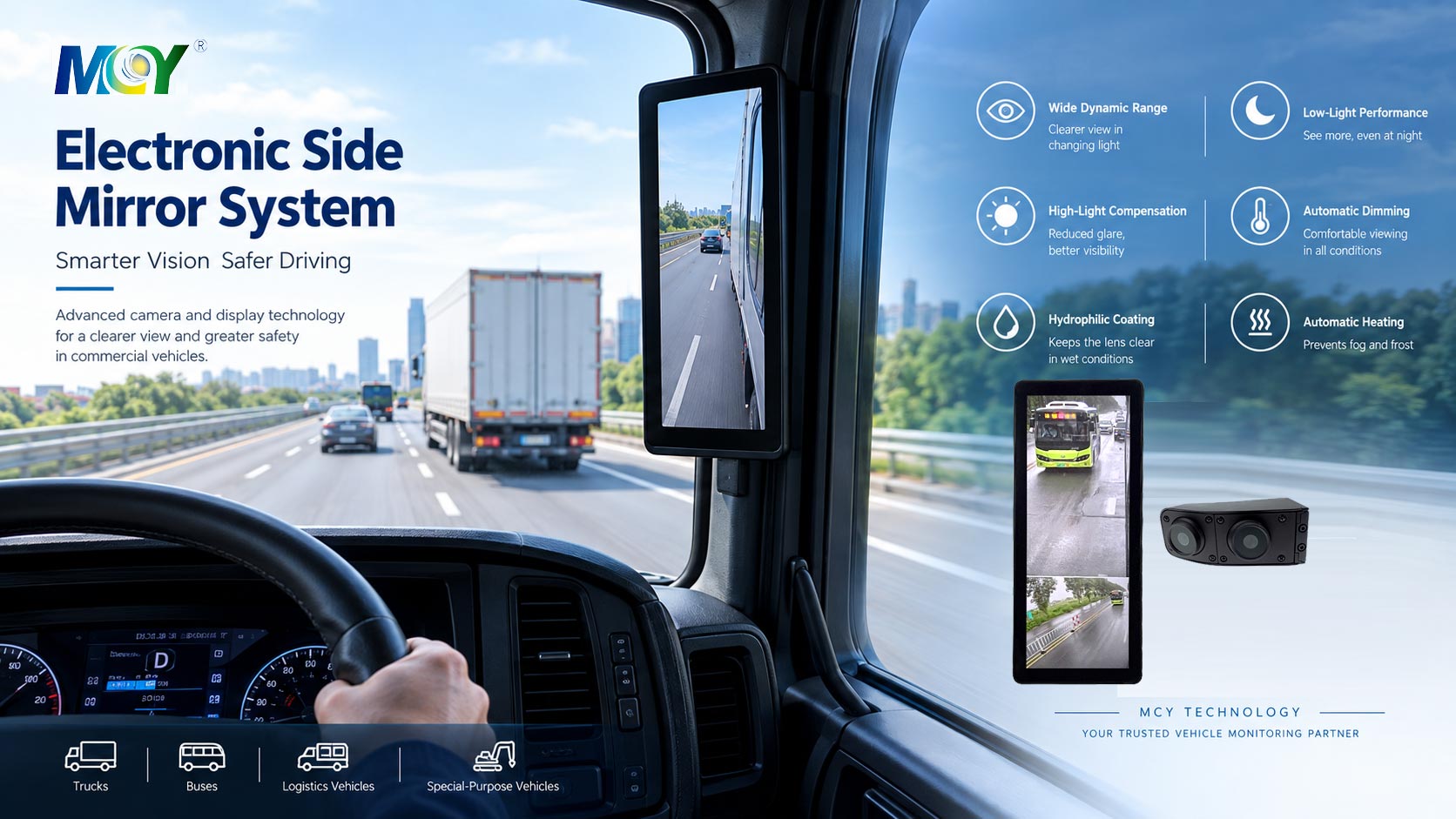
1. What Is an Electronic Side Mirror System?
An Electronic Side Mirror System is a digital rear-view solution that uses cameras mounted on the exterior of a vehicle to capture surrounding road conditions. The camera signals are transmitted to displays installed inside the cabin, allowing the driver to view traffic and other objects without relying solely on traditional exterior mirrors.
Unlike a conventional mirror, a camera-based system can incorporate image processing functions designed to address difficult lighting conditions and improve visual clarity. Depending on the system configuration, these functions may include wide dynamic range (WDR), automatic brightness adjustment, high-light compensation, and low-light image enhancement.
MCY Technology offers an E-Side Mirror® camera system designed to replace traditional exterior mirrors. Its 12.3-inch configuration uses dual-lens cameras mounted on the left and right sides of the vehicle, with images displayed on screens installed near the A-pillars. Buyers should confirm the configuration and specifications of the model selected for their application.
For commercial vehicle manufacturers and fleet solution providers, this technology provides an opportunity to integrate digital visibility into a broader vehicle safety system.
2. How an Electronic Side Mirror System Works
Understanding the operating principle helps buyers evaluate whether a digital mirror solution fits their vehicle platform.
2.1 Exterior Cameras Capture Road Conditions
The system uses cameras installed on the vehicle’s exterior to capture views of adjacent lanes and surrounding traffic. Camera positioning, lens characteristics, mounting height, and viewing angle all influence the final image.
For larger vehicles, such as buses and trucks, appropriate camera placement is particularly important because vehicle dimensions and body structures can create substantial blind spots.
During the selection process, B2B buyers should provide vehicle drawings, installation locations, and visibility requirements wherever possible. This information helps suppliers assess the proposed arrangement before production or installation begins.
2.2 Digital Images Are Transmitted to Interior Displays
The captured images are transmitted to screens positioned within the driver’s field of view. With MCY’s E-Side Mirror® solution, the displays are mounted near the A-pillars, allowing drivers to observe the digital side views from inside the cabin.
The display position should support a natural viewing direction without unnecessarily distracting the driver. Screen readability, mounting stability, cable routing, and integration with the vehicle interior should all be considered during system design.
2.3 Image Processing Supports Visibility
Driving conditions can change rapidly. A vehicle may move from bright sunlight into a tunnel, encounter headlights at night, or operate in heavy rain.
An Electronic Side Mirror System may incorporate image-enhancement technologies to help maintain a useful view under these conditions. However, the effectiveness of each feature depends on the camera, display, processing design, and operating environment.
Buyers should evaluate the complete system rather than assuming that a single feature guarantees clear images in every situation.
3. Key Features of an Electronic Side Mirror System
When comparing suppliers, purchasers should focus on features that address actual operating requirements.
3.1 Wide Dynamic Range for Changing Light Conditions
Wide dynamic range (WDR) helps balance bright and dark areas within an image. This is useful when vehicles enter tunnels, pass through covered parking areas, or encounter strong differences in illumination.
For fleet operators, balanced images can make surrounding objects easier to distinguish. Buyers should request demonstrations under representative lighting conditions instead of relying exclusively on product descriptions.
3.2 High-Light Compensation and Automatic Dimming
Strong sunlight, headlights, and spotlights can affect image visibility. High-light compensation is designed to manage intense light sources, while automatic dimming adjusts display brightness according to ambient lighting.
These functions can help reduce visual discomfort during day-to-night transitions. For distributors and vehicle integrators, it is worth checking how the system behaves during rapid changes in brightness and whether the display remains comfortable to view over extended driving periods.
3.3 Hydrophilic Coating and Weather Adaptation
Water droplets on a camera lens can distort the captured image. MCY identifies hydrophilic coating as one of the features of its E-Side Mirror® solution. This coating helps water spread across the surface rather than remaining as isolated droplets.
Some configurations also incorporate an automatic heating function for low-temperature conditions. Buyers operating vehicles in cold, wet, or variable climates should confirm which environmental features are included in the selected model.
3.4 Low-Light Image Performance
Night driving and poorly illuminated roads can make it difficult to identify surrounding vehicles and obstacles. Low-light image technology aims to preserve useful visual details while managing image noise.
For long-distance trucks, public transport fleets, and commercial vehicles that operate after dark, night-time performance should be a major evaluation criterion.
4. Benefits of an Electronic Side Mirror System for Commercial Vehicles
4.1 Improved Visibility Around Large Vehicles
Large commercial vehicles have significant visibility challenges because of their dimensions, body design, and operating environment. Digital side views can help drivers monitor adjacent traffic and surrounding road conditions.
This can be particularly valuable when changing lanes, turning, reversing, or navigating confined spaces. Nevertheless, a camera-based mirror system should be evaluated as part of the vehicle’s overall visibility strategy, not as a substitute for safe driving practices.
4.2 Greater Flexibility in Vehicle Design
Traditional exterior mirrors require physical housings and mounting structures. A digital mirror architecture changes how side-view information is captured and presented, potentially offering vehicle designers more flexibility in exterior packaging.
Manufacturers can assess whether a digital solution supports their styling, aerodynamic, and cabin-layout objectives. Any expected aerodynamic or energy-efficiency benefits should be verified for the specific vehicle design rather than assumed.
4.3 Support for Modern Fleet Safety Strategies
An Electronic Side Mirror System can form part of a wider in-vehicle monitoring solution. Depending on the vehicle’s architecture, it may complement other technologies such as blind spot detection (BSD), driver state monitoring (DSM), and advanced driver assistance systems (ADAS).
MCY supplies vehicle monitoring products and solutions across several commercial applications. Buyers planning an integrated project can discuss whether the electronic mirror system should operate independently or alongside other compatible monitoring equipment.
4.4 Potential Long-Term Operational Value
Fleet managers must consider the total cost of ownership, including installation, maintenance, downtime, replacement parts, and driver training.
A digital mirror system may offer operational advantages when its visibility performance and integration are appropriate for the application. However, the business case should be assessed using the vehicle’s actual operating conditions, maintenance requirements, and procurement costs.
5. Electronic Side Mirror System Applications
5.1 Trucks and Heavy-Duty Commercial Vehicles
Trucks frequently operate on highways, in urban traffic, and at loading facilities. Their size can make side visibility especially challenging during lane changes and tight turns.
An Electronic Side Mirror System can provide digital side views that support the driver’s observation of adjacent lanes. Truck manufacturers and fleet conversion companies should verify camera positioning, display placement, vibration resistance, and compatibility with the vehicle’s electrical architecture.
5.2 Buses and Public Transportation
Buses operate in environments where passenger safety, pedestrian awareness, and frequent manoeuvring are important. Digital side-view systems can support visibility around the vehicle during turns, stops, and movement through congested streets.
For bus OEMs and public transportation projects, purchasing teams should also assess passenger compartment layout, driver ergonomics, maintenance access, and any applicable local vehicle requirements.
5.3 Logistics and Distribution Fleets
Distribution vehicles often enter warehouses, loading bays, delivery zones, and narrow urban streets. These environments combine limited space with frequent interactions between vehicles, pedestrians, and fixed structures.
A suitable digital mirror solution can contribute to a broader visibility and fleet safety strategy. Logistics operators should assess performance under both indoor and outdoor lighting, as well as the practical requirements of fleet-wide installation.
5.4 Special-Purpose and Engineering Vehicles
Engineering vehicles may operate in demanding environments with vibration, dust, moisture, and restricted visibility. In these applications, buyers should pay particular attention to mounting strength, environmental protection, cable management, and serviceability.
The appropriate system configuration depends on the vehicle and project requirements. A technical discussion with the supplier can help determine whether a standard product or a customized configuration is more suitable.
6. How B2B Buyers Should Select an Electronic Side Mirror System
Selecting a supplier is a technical and commercial decision. The following criteria can help purchasing teams develop a more effective evaluation process.
6.1 Define Vehicle Compatibility
Before requesting a quotation, prepare the basic information required to assess compatibility:
- Vehicle type, model, and intended operating environment.
- Left- and right-side camera mounting positions.
- Preferred screen size and installation location.
- Electrical power requirements and interface expectations.
- Environmental conditions, including temperature, moisture, and vibration.
- Project quantity, delivery schedule, and expected service life.
Providing these details helps suppliers evaluate feasibility and reduce unnecessary changes during installation.
6.2 Evaluate Image Quality and Environmental Protection
Do not compare products on screen resolution or advertised features alone. Request sample footage or a demonstration covering daytime, night-time, strong backlighting, and wet-weather conditions where relevant.
Review the environmental protection ratings, temperature requirements, lens maintenance procedures, and connector design documented for the exact model.
MCY’s published E-Side Mirror® information describes features including WDR, high-light compensation, automatic dimming, hydrophilic coating, low-light technology, and automatic heating. Buyers should confirm availability and specifications for their chosen configuration.
6.3 Check Regulatory and Vehicle Approval Requirements
Electronic mirror systems may be subject to vehicle-specific and market-specific requirements. The applicable rules can depend on vehicle category, intended use, installation design, and destination market.
Importers and vehicle manufacturers should identify the required approvals before placing a purchase order. Ask the supplier to provide relevant documentation for the exact product and intended application, and independently verify its applicability.
Avoid assuming that an approval or certification associated with one model automatically applies to every product in a supplier’s range.
6.4 Assess OEM/ODM and Customization Capabilities
For OEMs, project contractors, and distributors developing their own product offerings, customization can be a significant purchasing factor.
Discuss camera positioning, display mounting, cable length, system interfaces, branding requirements, packaging, and other project-specific considerations. Confirm which changes are technically feasible, whether tooling or engineering work is required, and how modifications affect lead time and cost.
A supplier with relevant engineering experience can help coordinate these requirements before the project enters mass production.
6.5 Compare Total Cost Rather Than Unit Price Alone
A low initial quotation does not necessarily represent the best long-term value. Buyers should consider the complete package, including cameras, displays, mounting components, wiring, installation, technical documentation, spare parts, and after-sales support.
For distributors and wholesalers, consistency between batches, replacement availability, packaging, and clear product documentation are also important. Establishing these expectations early can help reduce procurement risks and simplify ongoing fleet support.
7. Why Choose MCY Technology for Electronic Side Mirror System Projects?
MCY Technology Limited supplies in-vehicle surveillance products and offers OEM/ODM services to customers worldwide. The company’s product portfolio includes electronic side mirror solutions, vehicle cameras, camera-monitor kits, mobile DVRs, and related monitoring equipment.
For B2B buyers, this broader product range provides an opportunity to discuss electronic mirrors within the context of a complete vehicle monitoring project.
Potential advantages of working with MCY include:
- Application-oriented product selection: Discuss system requirements according to vehicle type and operating environment.
- Engineering support: MCY reports a team of engineers with automotive industry experience, supporting technical discussions and project evaluation.
- OEM/ODM cooperation: Explore customization requirements for vehicle manufacturers, distributors, and project integrators.
- Related monitoring solutions: Evaluate whether additional cameras, displays, or vehicle monitoring products are appropriate for the same project.
- Direct supplier communication: Contact MCY to clarify specifications, documentation, quotation details, and project schedules.
You can explore the MCY E-Side Mirror® solution or review the broader MCY product range before discussing your requirements with the company.
The final purchasing decision should be based on verified product documentation, vehicle compatibility, application testing, and the requirements of the destination market.
8. Frequently Asked Questions About Electronic Side Mirror System
Q1. What is the main purpose of an Electronic Side Mirror System?
Its main purpose is to replace conventional exterior mirror views with images captured by external cameras and displayed on screens inside the vehicle. The system can help drivers observe surrounding traffic and address certain visibility limitations associated with traditional mirrors.
Q2. Can an Electronic Side Mirror System be installed on trucks and buses?
Yes, digital mirror systems can be considered for suitable truck and bus applications. However, camera placement, display positioning, electrical compatibility, environmental conditions, and applicable vehicle regulations must be evaluated for each vehicle platform.
Q3. Which features should buyers prioritize?
Image quality, WDR, low-light performance, glare management, weather adaptation, display readability, environmental protection, and installation compatibility are important considerations. The priority of each feature depends on the vehicle’s operating conditions and project requirements.
Q4. Does MCY Technology support OEM/ODM projects?
MCY states that it provides OEM/ODM services for customers worldwide. Buyers should contact the company to discuss customization feasibility, technical requirements, minimum order quantities, lead times, and project-specific commercial terms.
Q5. How can importers and distributors request a quotation?
Prepare the target vehicle type, expected order quantity, destination market, preferred configuration, and any relevant technical requirements. Contact MCY directly to request a suitable product recommendation, quotation, and available documentation.
Q6. What should buyers verify before importing an electronic mirror system?
Confirm the exact model specifications, compatibility with the target vehicle, applicable regulatory requirements, environmental performance, warranty terms, spare-part availability, packaging, and shipping arrangements. Request supporting documentation before finalizing the purchase.
Conclusion: Find the Right Electronic Side Mirror System for Your Project
An Electronic Side Mirror System is an important option for commercial vehicle manufacturers and fleet operators seeking to modernize driver visibility. By combining external cameras with interior displays and image-enhancement technologies, it can support visibility in a range of operating conditions.
For B2B procurement teams, the most suitable solution is not necessarily the one with the longest feature list or the lowest unit price. It is the system that meets the vehicle’s technical requirements, performs reliably in its intended environment, satisfies applicable regulations, and offers dependable supplier support.
MCY Technology provides electronic side mirror solutions alongside a wider range of in-vehicle monitoring products and OEM/ODM services. Whether you are a vehicle manufacturer, importer, distributor, wholesaler, or engineering contractor, the next step is to define your application and evaluate the appropriate configuration.
Contact MCY Technology to discuss your Electronic Side Mirror System requirements. Share your vehicle type, project quantity, target market, and customization needs to request product information and a quotation.
Website: https://www.mcytech.com/
Email: sales@mcytech.com
Phone: +86-760-86638369
MCY’s team can help you evaluate suitable options for your commercial vehicle monitoring project.
Post time: Oct-21-2026