
A large vehicle can have significant blind spots around its front, rear, and sides. When a bus turns through a crowded intersection, a truck reverses into a loading area, or an RV maneuvers into a narrow parking space, the driver may not have a clear view of every nearby obstacle. These visibility challenges can increase collision risks, vehicle damage, and disputes after an incident.
A 360 Degree Camera System helps drivers understand the area around their vehicles by combining images from multiple cameras into a panoramic surround view. Instead of relying only on traditional mirrors or a single reversing camera, drivers can see more of the vehicle’s immediate surroundings on a display. Depending on the system configuration, additional functions such as AI-based object detection and video recording can support safer maneuvering and incident investigation.
MCY Technology provides a 360 SVM Camera System designed to create a panoramic bird’s-eye view for different vehicle applications. For fleet operators, vehicle manufacturers, importers, and system integrators, choosing the right 360 Degree Camera System can be an important step toward improving visibility, managing risk, and building a more practical vehicle safety solution.
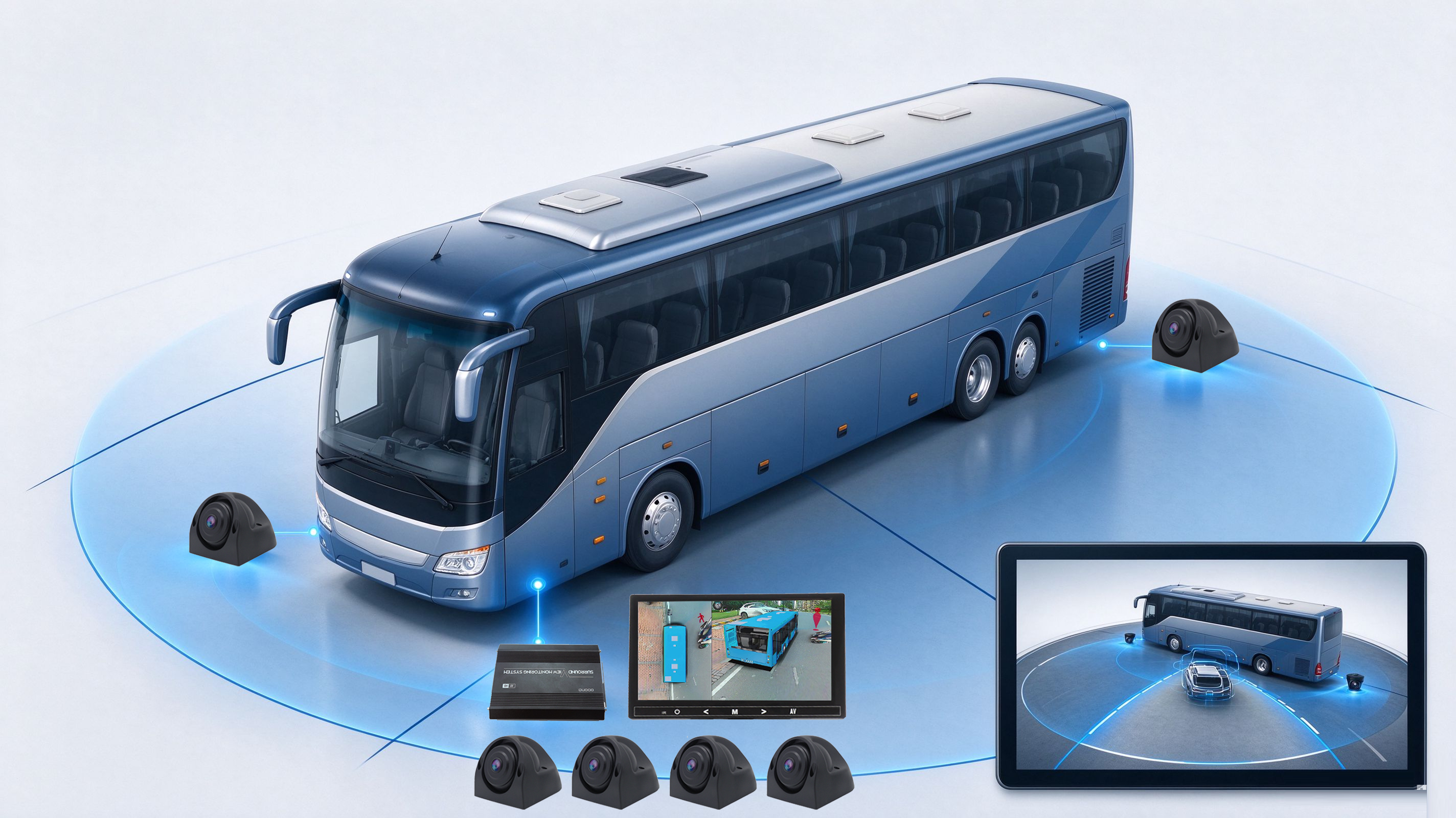
What Is a 360 Degree Camera System?
A 360 Degree Camera System, also known as a 360-degree surround-view monitoring system or SVM system, uses multiple cameras positioned around a vehicle to capture images from different directions. The system processes these images and combines them into a unified view of the vehicle’s surroundings.
A typical vehicle surround-view configuration places cameras at the front, rear, left, and right sides. Image processing software corrects lens distortion and merges the camera feeds to create a panoramic view. The driver can then see nearby obstacles and the vehicle’s position in relation to surrounding objects.
MCY’s 360 SVM Camera System uses four cameras to synthesize a 360-degree panoramic bird’s-eye view. The product information also describes distortion correction, 3D and 360-degree video merging, dynamic view-angle switching, blind-spot coverage, and driving video recording. Actual functions and compatibility should be confirmed for the selected configuration.
How Does a 360 Degree Camera System Work?
The operating process generally involves four steps:
- Image capture: Cameras mounted around the vehicle capture different areas near the body.
- Image processing: The system corrects lens distortion and processes the separate camera images.
- Panoramic image synthesis: The processed images are combined to create a surrounding view.
- Driver display: The resulting image is shown on a compatible screen so the driver can assess nearby obstacles and maneuver more confidently.
Some configurations also support AI-based pedestrian or vehicle detection. Where this function is included, the system may help alert drivers to potential hazards in selected areas. Detection performance depends on the configuration, installation, operating environment, and system settings.
Key Benefits of a 360 Degree Camera System
1. Reduce Blind-Spot Risks During Maneuvering
Blind spots are a major concern for buses, trucks, commercial vans, and other large vehicles. The vehicle body, cargo, mirrors, and driving position can limit the driver’s direct view of pedestrians, cyclists, nearby vehicles, or low obstacles.
A 360 Degree Camera System provides a broader visual reference by combining camera images from multiple sides. This can be particularly useful when the vehicle is reversing, turning at low speed, parking, or moving through a confined work area.
For fleet operators, better surrounding visibility can help drivers make more informed decisions. It can also support training by giving drivers and supervisors a clearer understanding of how blind spots affect vehicle movement.
A surround-view camera system should be treated as a driver-assistance tool rather than a replacement for mirrors, direct observation, or safe driving procedures.
2. Make Parking and Low-Speed Driving Easier
Parking and maneuvering often require drivers to judge the distance between a vehicle and nearby objects. This can be difficult for long-wheelbase buses, delivery trucks, motorhomes, and vehicles operating in busy depots.
A 360 Degree Camera System can help drivers assess the space around the vehicle while approaching loading bays, entering parking spaces, reversing into workshops, or maneuvering near walls and equipment. A bird’s-eye view gives the driver a more comprehensive visual reference than a rear-facing camera alone.
The benefit is especially relevant in environments where vehicles repeatedly operate in tight spaces. Reducing uncertainty during routine maneuvering can help operators manage avoidable damage and improve confidence behind the wheel.
3. Support Vehicle Safety and Fleet Management
Fleet safety involves more than preventing road collisions. Operators also need to manage reversing incidents, vehicle damage, passenger safety, loading-area risks, and disputes involving other road users.
A 360 Degree Camera System can form part of a broader vehicle monitoring solution. When combined with compatible recording equipment and other safety technologies, it may help operators review the circumstances surrounding an incident and identify opportunities to improve driver procedures.
For example, fleet managers can use recorded footage, where available, to review how a vehicle approached an obstacle, whether the surrounding area was visible, and how the driver responded. These reviews can inform driver training and operational improvements.
MCY also provides vehicle monitoring products and solutions for different vehicle types. Explore the company’s vehicle solutions to see how camera-based safety systems can be matched to specific operating environments.
4. Provide Video Evidence for Incident Investigation
When a collision, property-damage event, or disputed maneuver occurs, reliable video evidence can help establish what happened. Verbal accounts alone may not provide enough detail to reconstruct an event, especially when several vehicles or pedestrians are involved.
A 360 Degree Camera System with a compatible recording function can capture video around the vehicle, helping operators review surrounding conditions before and during an incident. MCY’s 360 SVM product information includes driving video recording and G-sensor-triggered recording.
Recorded footage can help with internal incident reviews, insurance discussions, customer complaints, and driver coaching. However, the availability of footage depends on the system’s recording configuration, storage, settings, and operating condition. Operators should confirm retention periods, recording behavior, and data access procedures before deployment.
Businesses should also establish appropriate policies for video storage, access permissions, retention, and privacy compliance in each operating market.
Applications of a 360 Degree Camera System Across Vehicle Industries
Different vehicles face different visibility challenges. Selecting a suitable 360 Degree Camera System requires understanding the vehicle’s dimensions, working environment, typical maneuvers, and the risks operators want to address.
Public Transportation and Bus Fleets
Buses operate near pedestrians, cyclists, passenger stops, other vehicles, and roadside obstacles. Large vehicle dimensions can make tight turns and low-speed maneuvering difficult, especially in crowded urban areas or bus depots.
A 360 Degree Camera System can give bus drivers a wider view of nearby surroundings during turning, reversing, and parking. When video recording is included, the system can also support incident reviews involving vehicles, pedestrians, or property.
For public transport operators and bus manufacturers, the system may be considered alongside interior surveillance, mobile DVR equipment, and other driver-assistance technologies according to project requirements.
School Bus Operators
School buses require particular attention to visibility around the vehicle, especially during pickup, drop-off, and depot maneuvering. Children may move unpredictably and can be difficult to see from the driver’s position.
A properly installed surround-view system can improve the driver’s visual awareness of selected areas around the bus. Where compatible AI detection is available, it may provide additional alerts for detected pedestrians or vehicles.
A 360 Degree Camera System should complement established school-bus safety procedures, mirrors, driver training, and applicable local requirements. Buyers should evaluate camera coverage, display placement, and how the system performs in the environments where the bus operates.
Logistics, Freight, and Delivery Vehicles
Trucks and delivery vehicles often reverse toward loading docks, move through warehouses, and share confined spaces with forklifts or workers. Side and front blind spots can complicate low-speed maneuvers.
A 360 Degree Camera System can help drivers observe the vehicle’s immediate surroundings when positioning a truck, approaching a dock, or navigating a distribution yard. Recorded footage can also assist with reviewing loading-area incidents and vehicle damage.
For logistics companies, the value of a camera system depends on more than image display. Buyers should also consider recording requirements, compatibility with existing monitoring equipment, and the procedures used to retrieve footage after an incident.
Taxi and Commercial Passenger Vehicles
Taxi operators and other passenger transport businesses need to balance driving safety with operational accountability. A surround-view camera system can support low-speed parking and maneuvering in busy streets, garages, and passenger pickup areas.
When integrated into a suitable vehicle monitoring setup, camera recording can also help clarify incidents involving vehicle movement or nearby road users. Operators should determine whether their requirements extend to exterior views only or include additional in-cabin monitoring, which involves separate privacy and configuration considerations.
Recreational Vehicles and Motorhomes
RVs and motorhomes can be long, wide, and difficult to maneuver in unfamiliar locations. Campsites, narrow access roads, garages, and crowded parking areas may leave limited space around the vehicle.
A 360 Degree Camera System can provide a panoramic view to assist with parking and low-speed maneuvering. It may be particularly helpful for drivers who do not regularly operate large vehicles.
MCY lists recreational vehicles among its solution categories. Buyers should confirm camera placement, display compatibility, and the suitability of the chosen system for their vehicle’s layout.
Industrial, Construction, Mining, and Agricultural Vehicles
Industrial and off-road vehicles may work around equipment, materials, workers, and uneven terrain. Restricted visibility can create risks in yards, farms, construction sites, and industrial facilities.
A surround-view camera system can help operators observe nearby areas when maneuvering large equipment or moving through confined workspaces. The required setup will vary according to vehicle structure, vibration, exposure to dust or moisture, and the operating conditions.
For these applications, buyers should evaluate the complete installation rather than selecting cameras by appearance alone. Housing suitability, cable routing, mounting positions, display visibility, and maintenance access all affect practical performance.
How to Choose the Right 360 Degree Camera System
For importers, wholesalers, vehicle modification companies, OEMs, and system integrators, selecting a 360 Degree Camera System requires a structured assessment of the application.
1. Confirm Camera Coverage and Vehicle Layout
Start by identifying the vehicle’s main blind spots. Consider the front corners, side areas, rear overhang, and zones that become difficult to observe during turning or reversing.
Camera mounting positions should suit the vehicle body and provide the intended coverage. The system must also be calibrated correctly so the synthesized image offers a useful representation of the surrounding area.
2. Evaluate Image Processing and Display
A surround-view system depends on more than the number of cameras. Image distortion correction, the quality of image merging, display readability, and the ability to switch between views can affect usability.
Ask suppliers how the system presents the panoramic view, whether 2D or 3D views are supported, and how the display fits into the driver’s normal workflow. Demonstrations using a comparable vehicle can help buyers assess practical visibility.
3. Check Recording and Evidence Requirements
If incident investigation is a priority, confirm whether the system records video and how the footage is stored and retrieved. Buyers should clarify:
- Which camera views are recorded.
- Whether recording is continuous, event-triggered, or configured another way.
- How video is exported after an incident.
- What storage capacity and retention approach are required.
- Whether the system needs to work with existing recording equipment.
MCY offers Camera DVR Kits and other vehicle monitoring products. Compatibility between a 360 Degree Camera System and any additional recording equipment should be confirmed before ordering.
4. Consider AI Detection and Additional Safety Functions
Some applications may benefit from AI-based pedestrian or vehicle detection. These functions can provide additional awareness of selected hazards, but buyers should verify which detection features are included in the proposed system and whether they are suitable for the intended vehicle and environment.
Do not assume that every surround-view product includes identical AI functions. Request clear documentation of the selected configuration and the operating conditions for any detection or warning feature.
5. Plan Installation, Calibration, and Maintenance
Correct installation is essential to obtaining a useful panoramic image. Camera angles, mounting positions, wiring, calibration, and display location should be planned around the actual vehicle.
For fleet deployments, also consider installation time, replacement procedures, access to spare parts, technical support, and maintenance training. A system that is easy to inspect and service can be more practical for operators managing many vehicles.
6. Confirm Customization and Integration Needs
Different markets and vehicle platforms may require different camera housings, cable lengths, display arrangements, recording options, or installation methods. Vehicle manufacturers and modification companies may also need integration with existing electrical systems or monitoring equipment.
Before placing an order, share the vehicle type, intended application, installation drawings or photos where available, required functions, and expected order volume. This helps the supplier assess whether the proposed 360 Degree Camera System matches the project.
Why Consider MCY Technology for a 360 Degree Camera System?
MCY Technology supplies vehicle camera and monitoring products for a range of vehicle applications. Its product range includes the 360 SVM Camera System, camera DVR kits, HD cameras, monitors, mobile DVRs, and other vehicle safety solutions.
The company’s 360 Degree AI Camera Monitor System solution describes panoramic surround viewing, AI blind-spot detection, and video evidence for incident review. These functions may be relevant to operators who need to improve low-speed visibility while strengthening their incident-management process.
For overseas importers, wholesalers, vehicle modification workshops, bus manufacturers, and system integrators, the key is to match the product configuration to the target vehicle and market. Requirements can differ significantly between a school bus, an RV, a freight truck, and industrial equipment.
When contacting MCY, provide the following information to help clarify your project:
- Vehicle type and intended operating environment.
- Main blind spots or maneuvering challenges.
- Whether panoramic viewing, AI detection, video recording, or a combination is required.
- Existing displays, DVRs, or other equipment that may need to be integrated.
- Installation constraints and customization expectations.
- Target quantity and project schedule.
This information allows the discussion to focus on application suitability rather than relying on a generic product description.
Frequently Asked Questions About a 360 Degree Camera System
What is the main purpose of a 360 Degree Camera System?
Its main purpose is to provide a panoramic view of the area around a vehicle by combining images from multiple cameras. It helps drivers observe nearby obstacles during parking, reversing, turning, and other low-speed maneuvers.
How many cameras does a 360-degree surround-view system use?
A common configuration uses four cameras positioned at the front, rear, left, and right sides of the vehicle. The actual arrangement depends on the product design and the vehicle’s layout. MCY’s 360 SVM Camera System uses four cameras to create a panoramic view.
Can a 360 Degree Camera System record video evidence?
Yes, if the selected system includes a recording function. MCY’s 360 SVM product information lists driving video recording and G-sensor-triggered recording. Buyers should confirm the exact recording behavior, storage arrangement, and footage-export process for their chosen configuration.
Is a 360 Degree Camera System suitable for buses and trucks?
It can be suitable for buses, trucks, school buses, motorhomes, and other vehicles where surrounding visibility is important. Suitability depends on the vehicle layout, installation, operating environment, and selected functions.
Does every 360 Degree Camera System include AI detection?
No. AI detection is a configuration-dependent feature. Buyers should confirm whether pedestrian or vehicle detection is included, which areas are monitored, and how alerts are delivered.
Can the system be customized for different vehicles?
Customization and integration requirements should be assessed with the supplier. Vehicle type, mounting locations, display requirements, recording needs, and compatibility with existing equipment should be discussed before the order is finalized.
Conclusion: Choose a 360 Degree Camera System for Your Vehicle Application
A 360 Degree Camera System can improve a driver’s awareness of the surrounding environment by combining multiple camera views into a panoramic image. For public transport, school buses, logistics fleets, RVs, industrial vehicles, and other commercial applications, this broader view can support safer maneuvering and help reduce uncertainty around blind spots.
When video recording is included, the system can also support incident investigation and evidence management. The best configuration depends on the vehicle, operating conditions, required camera coverage, recording needs, and any integration or customization requirements.
MCY Technology offers a 360 SVM Camera System and related vehicle monitoring products for different applications.
Looking for a 360 Degree Camera System for your fleet or vehicle project? Contact MCY Technology to discuss your vehicle type, camera coverage, recording requirements, and customization needs.
Website: https://www.mcytech.com/
Email: sales@mcytech.com
Phone: +86-760-86638369
Post time: Oct-26-2026