
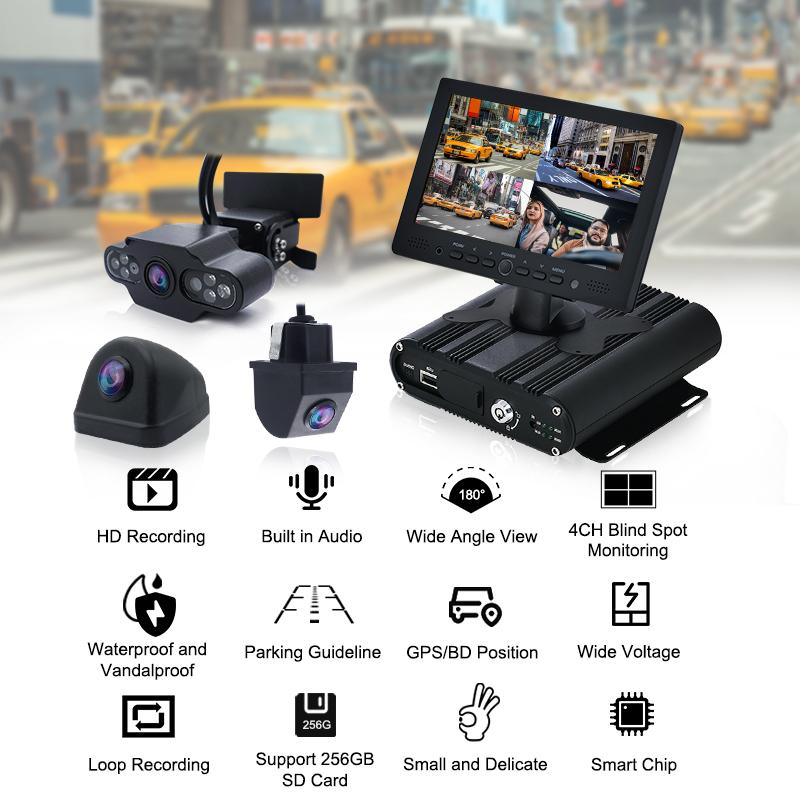
Taxi companies, ride-hailing platforms, and commercial transportation operators face increasing demands for passenger safety, driver protection, and efficient fleet management. Every vehicle may operate for many hours each day, travel through unfamiliar locations, and carry passengers with different needs. Traffic accidents, passenger disputes, theft, vandalism, and unexpected emergencies can create operational and financial challenges.
A Taxi Vehicle Surveillance Camera Kit provides an integrated way to monitor activity inside and around a vehicle. By combining multiple cameras, a Mobile DVR, GPS positioning, and remote monitoring functions, operators can record important events, review incidents, and gain better visibility into daily fleet operations.
These requirements also apply to buses, school buses, trucks, forklifts, recreational vehicles, and other special-purpose vehicles. Vehicle manufacturers, fleet operators, security equipment distributors, and system integrators increasingly need camera solutions that can be adapted to different vehicle structures and operating environments.
MCY Technology provides vehicle camera and monitoring products for commercial transportation and special vehicles. Its taxi surveillance solution combines multi-camera recording, GPS tracking, infrared night vision, and emergency alert functions to support professional fleet applications.
This article explains the essential components, practical benefits, and selection considerations for an integrated taxi surveillance solution, with additional guidance for other commercial vehicle applications.
Why Choose a Taxi Vehicle Surveillance Camera Kit?
Taxi operations involve more than transporting passengers from one destination to another. Drivers work independently, vehicles travel through busy urban areas, and fleet managers may have limited direct visibility into what happens during each journey.
A Taxi Vehicle Surveillance Camera Kit helps bridge this information gap by recording selected areas inside and outside the vehicle. Instead of depending entirely on driver reports or passenger complaints, authorized personnel can review video footage when an incident requires investigation.
Improve Driver and Passenger Security
A taxi is a relatively confined environment where drivers and passengers share the same space. Disagreements, aggressive behavior, theft, and other unexpected situations may occur during a journey.
An interior camera can record passenger activity, while an external camera can capture road conditions and events around the vehicle. Having these views available can provide additional information when a complaint or safety incident needs to be reviewed.
For operators managing night-time transportation, cameras with suitable infrared night vision can also help maintain visibility in low-light conditions.
Preserve Video Evidence for Incident Investigation
Video evidence is valuable when investigating traffic accidents, passenger disputes, vehicle damage, and service complaints. A recording system can help establish the sequence of events and provide context that may not be available from written reports alone.
A Mobile DVR connected to multiple cameras can store footage from different areas of a vehicle. Depending on the system configuration, recordings may include the road ahead, passenger cabin, rear area, and selected side views.
Improve Fleet Visibility and Management
For companies operating large numbers of taxis or commercial vehicles, managing individual vehicles can be challenging. GPS positioning and remote monitoring functions can help fleet managers understand where vehicles are operating and access available vehicle information.
When connected to a compatible platform, the monitoring system can support vehicle scheduling, route review, and operational coordination. These functions are particularly useful for ride-hailing platforms, airport transfer services, and transportation companies with multiple operating locations.
Main Components of a Taxi Vehicle Surveillance Camera Kit
An integrated vehicle monitoring system consists of several components that work together. The final configuration should match the vehicle type, camera coverage requirements, recording needs, and fleet management objectives.
Multi-Camera Coverage for Different Vehicle Areas
A multi-camera arrangement provides more comprehensive monitoring than a single front-facing camera. Depending on the vehicle and project, cameras can be installed to monitor:
- Front view: Records road conditions and traffic events ahead of the vehicle.
- Cabin view: Captures selected passenger and driver activities.
- Rear view: Provides additional visibility behind the vehicle.
- Side view: Monitors selected areas beside the vehicle where blind spots may exist.
For taxi applications, interior and front-facing cameras are often important. Larger commercial vehicles, such as buses and trucks, may require additional side and rear cameras.
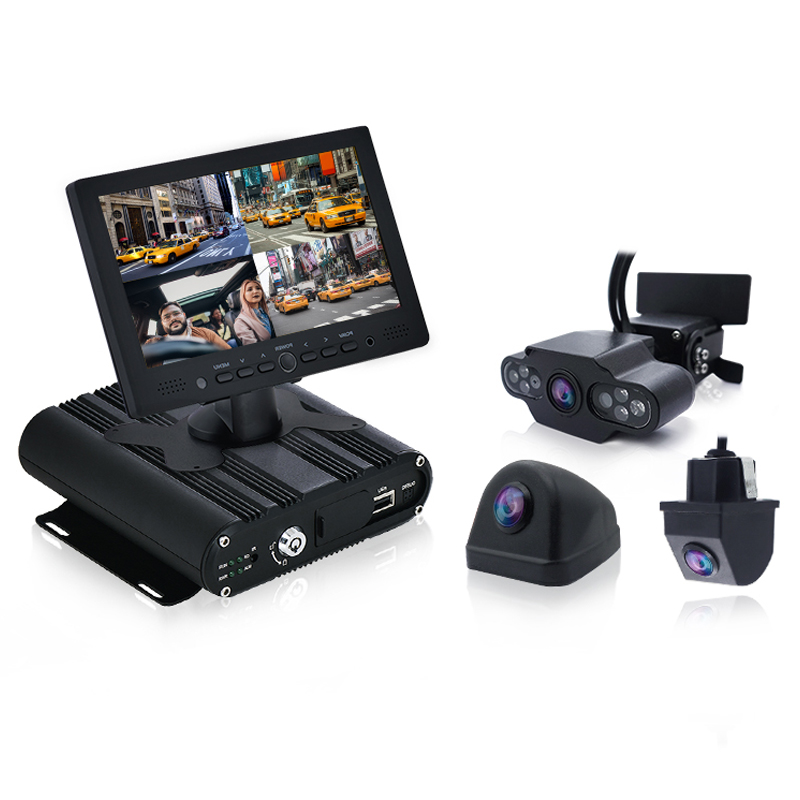
MCY’s taxi surveillance product is designed around a four-channel camera configuration, allowing multiple camera positions to be included according to the installation requirements.
Product reference: MCY Taxi CCTV Camera and Mobile DVR Kit.
Mobile DVR for Reliable Video Recording
The Mobile DVR is the central recording component of a vehicle surveillance system. It receives video from connected cameras and stores footage for playback and investigation.
Unlike a monitor that only displays live images, a recording device preserves video for later access. This is important for transportation companies that need to review events after a journey or investigate a reported incident.
MCY provides different Mobile DVR configurations for commercial vehicle applications. Depending on the selected model, functions may include video storage, playback, GPS positioning, wireless transmission, and remote video monitoring.
Explore MCY Mobile DVR Products.
GPS Tracking and Remote Monitoring
GPS positioning helps fleet managers identify vehicle locations and review routes. When compatible 3G/4G or Wi-Fi functions are included, the system may also support remote access to video and other vehicle information.
For taxi platforms, these functions can help coordinate vehicles across different service areas. For logistics companies, they can support transportation supervision and route management.
Buyers should confirm the communication modules, software platform, and remote access requirements of the selected model before purchasing.
Infrared Night Vision and Emergency Alert Functions
Taxi services frequently operate early in the morning and late at night. Cameras with infrared night vision can help capture images when visible light is limited.
An emergency alert function can also provide an additional way for drivers to request assistance. MCY’s taxi surveillance product information lists a panic button among its features. Buyers should confirm how the alert is triggered, where the signal is sent, and whether it requires integration with an external monitoring platform.
Important Features of a Taxi Vehicle Surveillance Camera Kit
Different transportation businesses have different monitoring priorities. A small taxi company may need basic cabin recording, while a large ride-hailing platform may require GPS tracking, remote video access, and centralized fleet management.
When evaluating a Taxi Vehicle Surveillance Camera Kit, buyers should consider the following features rather than comparing products only by price.
Camera Channels and Recording Coverage
The number of camera channels determines how many camera views the system can support. Buyers should select a recording device that matches the intended camera configuration.
A four-channel system may be appropriate for a taxi requiring front, cabin, rear, and one additional view. A bus, coach, or heavy-duty truck may need a system with more channels.
It is also important to confirm camera compatibility, video input formats, cable requirements, and installation positions before ordering.
Video Quality and Storage Capacity
Video quality affects how easily operators can identify details during playback. Resolution, recording settings, storage capacity, and video compression should all be considered.
The required storage capacity depends on the number of cameras, recording resolution, frame rate, and expected recording duration. Fleets should establish how long footage needs to be retained and how authorized personnel will retrieve it.
Connectivity and Platform Compatibility
A vehicle surveillance system may support local recording without requiring an internet connection. However, fleets that need remote monitoring should check whether the selected model supports the required wireless communication functions.
MCY’s MAR-SL04 Mobile DVR, for example, supports H.264/H.265 video codecs, SD card storage, and optional 3G/4G, Wi-Fi, and GPS functions. The product page lists support for up to two 256GB SD cards.
See the MAR-SL04 4CH Dual SD Card Mobile DVR.
Installation and Vehicle Compatibility
Commercial vehicles differ in electrical systems, cabin layouts, body dimensions, and available mounting positions. A suitable camera system must be compatible with the target vehicle and installed securely.
For vehicle manufacturers and retrofit companies, installation planning should include power supply requirements, camera angles, cable routing, monitor positioning, and maintenance access.
Applications of a Taxi Vehicle Surveillance Camera Kit Beyond Taxis
Although taxi monitoring is the primary application, similar camera and recording technologies can serve many commercial vehicles. The configuration should be adjusted to each vehicle’s dimensions and operational requirements.
Buses and School Buses
Buses transport large numbers of passengers and often operate on fixed routes or scheduled services. Operators may need to monitor the driver area, passenger cabin, vehicle entrance, road ahead, and rear surroundings.
A multi-channel Mobile DVR system can connect cameras at different positions and preserve recordings for later review. Depending on the project, additional AI detection or driver monitoring functions may also be considered.
MCY’s Camera DVR Kits include configurations for buses, school buses, taxis, trucks, coaches, and other vehicles.
Heavy Trucks and Logistics Fleets
Freight trucks operate on highways, in warehouses, at loading docks, and across distribution centers. Their monitoring requirements may include front and rear recording, side visibility, driver behavior monitoring, and GPS tracking.
An integrated vehicle recording system can help fleet managers review transportation events and investigate incidents involving cargo or vehicle damage.
For more advanced applications, MCY’s Logistics Transport Solution combines Mobile DVR monitoring with ADAS, DSM, BSD, GPS positioning, and remote video functions.
Forklifts and Engineering Machinery
Forklifts, cranes, and construction vehicles often operate around workers, materials, and other equipment. Their large structures can create blind spots, especially during reversing and turning.
These vehicles may require specialized cameras, blind-spot detection, and warning functions rather than a standard taxi configuration. Buyers should evaluate the working environment and select equipment suitable for vibration, dust, moisture, and installation conditions.
RVs and Special-Purpose Vehicles
Recreational vehicles and motorhomes have larger dimensions than passenger cars. Drivers may need additional rear and side views when reversing, parking, or maneuvering in narrow spaces.
A multi-camera recording solution can provide additional visual coverage and preserve footage, depending on the selected configuration. Similar requirements can apply to utility vehicles, service vehicles, and specialized commercial transportation equipment.
How to Select the Right Taxi Vehicle Surveillance Camera Kit
Choosing the right system starts with identifying what the fleet needs to monitor, record, and manage. Before requesting a quotation, buyers should prepare the following information:
- Vehicle type and quantity: Identify whether the project covers sedans, MPVs, vans, buses, trucks, or mixed fleets.
- Camera coverage: Decide whether front, cabin, rear, and side cameras are required.
- Recording channels: Confirm how many camera inputs the recording device must support.
- Night-time operation: Determine whether infrared night vision is necessary.
- GPS and remote monitoring: Identify whether location tracking and remote video access are required.
- Storage requirements: Estimate the recording period and expected video data volume.
- Emergency functions: Confirm whether a panic button or external alert integration is needed.
- Installation compatibility: Check power supply, mounting positions, cable routing, and vehicle-specific requirements.
- Privacy and data management: Define recording notices, access permissions, and footage retention procedures in accordance with local regulations.
For wholesalers and distributors, it is also useful to confirm product configurations, accessories, technical documentation, packaging, and OEM/ODM requirements before establishing a long-term supply relationship.
Customized Taxi Vehicle Surveillance Camera Kit Solutions from MCY
Different customers may need different combinations of cameras, monitors, recording devices, and communication functions. A taxi platform may prioritize passenger cabin recording and GPS tracking, while a bus manufacturer may require more channels and broader vehicle coverage.
MCY Technology provides vehicle camera and monitoring products for commercial transportation and special-purpose vehicles. Its product range includes camera DVR kits, Mobile DVR systems, HD cameras, monitors, reverse cameras, AI detection products, and 360-degree camera systems.
For customers planning a vehicle surveillance project, customization discussions may include:
- Camera quantity and installation positions.
- Interior and exterior camera selection.
- Mobile DVR channel configuration.
- Video storage and playback requirements.
- GPS positioning and wireless communication.
- Infrared night-vision requirements.
- Monitor size and installation arrangement.
- Panic button and alert integration.
- OEM/ODM requirements for vehicle manufacturers and distributors.
MCY welcomes inquiries from taxi operators, vehicle manufacturers, commercial vehicle security wholesalers, fleet management integrators, and retrofit service providers.
Visit the MCY Solutions page to explore vehicle monitoring applications and discuss your project requirements with the team.
FAQ About Taxi Vehicle Surveillance Camera Kit
1. What is a Taxi Vehicle Surveillance Camera Kit?
It is an integrated vehicle monitoring solution combining cameras, a Mobile DVR, and related accessories to record selected areas inside and outside a taxi. Depending on the configuration, it may include GPS tracking, infrared night vision, remote monitoring, and emergency alert functions.
2. How many cameras can the system support?
The supported number depends on the recording device and selected configuration. MCY’s taxi surveillance solution is designed around four camera inputs, allowing multiple areas of the vehicle to be monitored.
3. Can the system record passenger activity?
Yes. When an interior camera is included and installed in a suitable position, it can record selected areas of the passenger cabin. Operators should follow applicable privacy laws and inform passengers about recording where required.
4. Does the system support GPS tracking?
MCY offers Mobile DVR products with GPS positioning options. The MAR-SL04 model lists GPS as an optional function, along with optional 3G/4G and Wi-Fi connectivity.
5. Can the cameras operate at night?
Selected MCY taxi surveillance cameras include infrared night vision. Buyers should confirm the capabilities of the specific camera model and its suitability for the intended mounting position.
6. Can fleet managers view vehicle footage remotely?
Remote monitoring is supported by compatible Mobile DVR configurations with the required communication modules and platform access. Buyers should confirm network requirements and software compatibility before purchasing.
7. Does MCY provide surveillance systems for buses and trucks?
Yes. MCY’s vehicle camera portfolio includes Mobile DVR systems and camera DVR kits for taxis, buses, school buses, trucks, coaches, and other commercial vehicles.
8. Can MCY support OEM/ODM projects?
MCY welcomes OEM/ODM inquiries. Customers can discuss camera configurations, recording channels, connectivity, installation requirements, and other project specifications with the company.
Conclusion: Build Safer Fleets with the Right Taxi Vehicle Surveillance Camera Kit
Effective vehicle surveillance supports passenger security, driver protection, incident investigation, and fleet management. For taxi operators and ride-hailing platforms, a properly configured monitoring solution can provide useful video records and better visibility into daily vehicle operations.
A Taxi Vehicle Surveillance Camera Kit can combine multi-camera coverage, Mobile DVR recording, GPS tracking, infrared night vision, and emergency alert functions according to the fleet’s requirements. Similar technologies can also support buses, school buses, trucks, forklifts, RVs, and other commercial vehicles.
MCY Technology provides vehicle camera and monitoring products for fleet operators, distributors, vehicle manufacturers, and system integrators. Whether you are sourcing taxi CCTV equipment, developing a commercial vehicle project, or looking for an OEM/ODM partner, MCY can help you explore a suitable configuration.
Contact MCY Technology today to discuss your vehicle surveillance project.
- Website: https://www.mcytech.com/
- Email: sales@mcytech.com
- Tel: +86-760-86638369
Share your vehicle type, target market, camera requirements, and estimated project quantity with the MCY team to start planning your vehicle monitoring solution.
Post time: Nov-10-2026